About Us
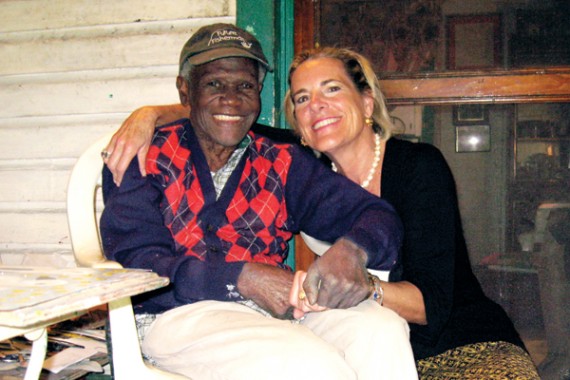
Amos Ferguson (Bahamas, 1920 – 2009) and Laurie Ahner at his studio in 2009.
Since 1980, Laurie Ahner has been able to share her particular love and passion for colorful art from around the world with others through her art gallery. She first discovered such art in Haiti, and since then her scope has broadened to include the Caribbean, Latin America, Eastern Europe, Western Europe, Southern Asia, Africa, the United States, and Canada. Her first trip to Haiti was in 1978 after the tragic death of her first husband, James G. Varley Jr. Laurie decided to visit Haiti and its wonderful artists who paint colorful and joyous works of art. She was immediately drawn to the primitive style and started to visit Haiti on a regular basis to buy art there.

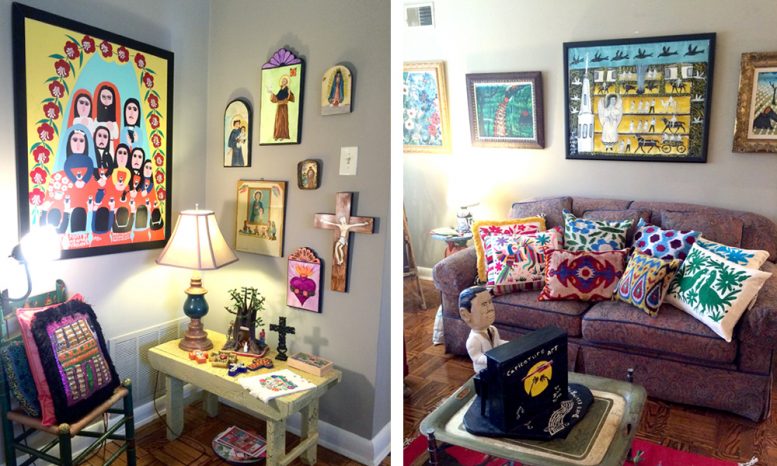
As an art history scholar and avid collector of this specialized art form, Laurie strives to bring international folk art to an ever-broadening audience through Galerie Bonheur, her residence and gallery, located in St. Louis (Missouri), Santa Fe (New Mexico), Stuart (Florida). The gallery represents world-renowned artists from around the globe, perhaps most notably including Amos Ferguson, who is often referred to as the Picasso of the Bahamas.

When asked about what draws her to folk art, Laurie says, “I find the general feeling of folk art happy, refreshing, expressive, and spiritual. It speaks from the heart and soul, and cheers me up every day of my life. Folk art is charming, and easy to understand and appreciate. It expresses the world as the everyday man sees it, conveys the joy found in nature and the beauty of the world God created. Folk art is full of such earnest feelings of faith and peace which have become hard to come by in our fast-paced and materialistic culture. I named my gallery “Bonheur” which is French for “happiness, good feelings, or joy” as these are the feelings that I think that art should bring into our lives.”

To that end, Laurie has written and published several books highlighting art and culture by region, as well as catalogs of works by individual artists. The first of these regional publications, “What Color is Joy – Guatemala,” which features over 200 photographs artfully arranged and narrated throughout 150 pages, is available through the gallery and the website. Other publications include “Amos Ferguson – Master of Color,” “Mary Whitfield – Remember your Past,” “Craig Norton – Trying to Change the World One Drawing at a Time,” and “John Barton – A Compulsion to Paint,” as well as individual catalogs of Paul Graubard and Janice Kennedy, artists represented by Galerie Bonheur.
Laurie travels extensively around the world to discover art and artists for her collection, and to develop relationships with the artists which last for many years. Her travels have taken her to many of the poorest and most faraway lands where tourists seldom venture. There she finds some of the most authentic, expressive and true forms of folk art from people who have not been influenced by the financial lure of the Western world and its constant hunger for money. These artists are making art for their own personal and spiritual expression and satisfaction, and often to support the basic human needs for clothing, shelter, and food. Thus, the works of art are a true and authentic example of their national culture.

Many of Laurie’s treasures are works of art never before seen in the United States. She has discovered folk art in remote towns in the Andes Mountains of Venezuela, dusty and poor villages in India, overlooked artists’ colonies in Guatemala, off-the-beaten track areas of Romania and Bulgaria, and other lands such as Trinidad and the Bahamas. As a gallery director and photo-journalist Laurie has visited Cuba four times to scout for unknown and neglected folk artists who may have been overlooked due to the US embargo. She has found Cuba to have a wealth of talent as well as inspirational and creative people.
The art pieces that Laurie finds always have an authenticity, and unique context and story behind them. These are not things that everyone else in one’s neighborhood owns, nor are they sold in most department stores or mass-retailers all over the world. They are special expressions by the artists who make them.
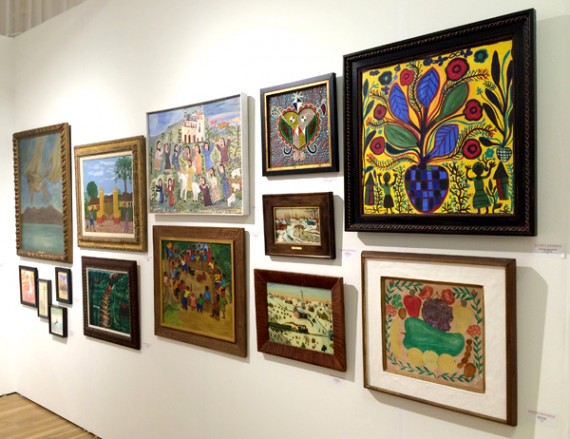
One of Laurie’s incentives is to bolster a dying breed of local artists and craftspeople. She is helping these artisans and supporting what they do. Handmade crafts and the techniques used to make them in these third world countries, and the artists as well are an “endangered species.” “I wear many of the beautiful textiles that I discover and have coats, jackets, bedspreads, quilts, handbags, etc. made from many of the intricate handwoven and handmade fabrics. These artists that I find are national treasures and they need the support and encouragement of the rest of the world to keep creating.”
Galerie Bonheur has exhibited broadly throughout the USA in Atlanta, Baltimore, Chicago, Michigan, Minneapolis, New York City, Pittsburgh, and Santa Fe.

The gallery also has a comprehensive website GalerieBonheur.com, presenting art and crafts from over 40 countries including: Africa, Argentina, the Bahamas, Brazil, Bulgaria, Chile, Costa Rica, Cuba, the Dominican Republic, Ecuador, Guatemala, Haiti, India, Jamaica, Peru, Poland, Romania, Venezuela, and USA, and featuring art in many mediums including paint, wood and metal sculpture, paper mâché, tapestry, sequins and beads, textiles, and ceramics. Exciting recent additions to the collection include fashions which Laurie has designed and which were created from textiles discovered in her travels.